
When I was very little, I remember sliced apple with cheddar, cream cheese spread on graham crackers, and meat-and-cheese platters on New Year's Eve. I remember a child's salad plate made up like a doll head: a canned pear half head with dried fruit facial features and shredded cheddar hair. And of course there are those Italian favorites: lasagne, stuffed manicotti, cannoli and the ever-present mozzarella-laden pizzas produced on every streetcorner in my hometown.
Clearly cheese has been an prominent player in my life.
I never considered making cheese at home. Then I saw Alton Brown talk about making cottage cheese. Then I joined Great Cook's Community, where some members discussed home cheesemaking. So I gave it a little thought, and I borrowed a book from the library.
Making Great Cheese at Home by Barbara Ciletti is a great tutorial for the beginner, and a few recipes that don't require any specialized equipment, or ingredients.
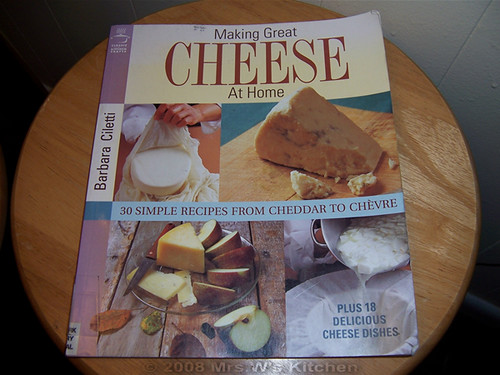
Just what I was looking for.
I decided that my first attempt would be Queso Blanco--a very simple recipe. However, instead of making the full recipe for my first try, I cut it in 4--from a gallon to a quart of milk. Here's what I did.
First, I borrowed a candy thermometer. I bought and hand-washed a new, undyed cotton tea towel (from the dollar store). Then I placed a colander in a large stainless bowl, put my new tea towel inside, then sprayed the interior with canola spray.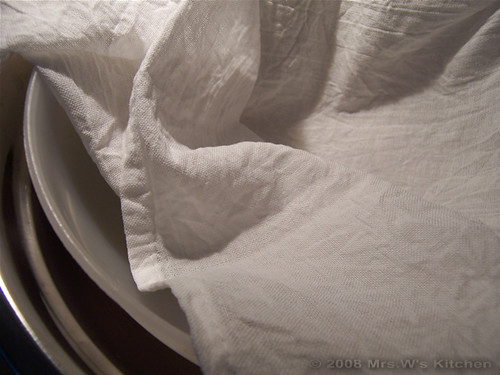
In a regular pot with the candy thermometer clipped to the side, I warmed 1 quart of organic, ultra-pasteurized whole milk over medium-low heat, slowly raising the temperature of the milk to 175*F, stirring frequently.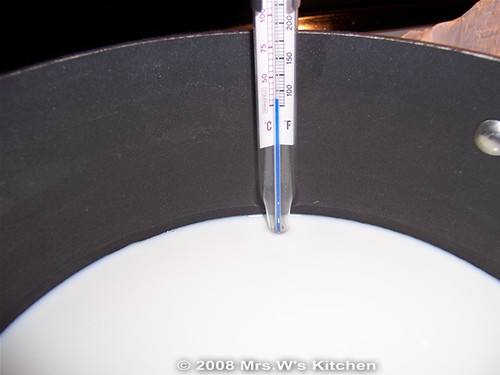
The stirring is important, and I did see bits of skin forming at the top of the milk. I just stirred them back in. I'm not sure if that was correct--the recipe did not address the milk 'skin.'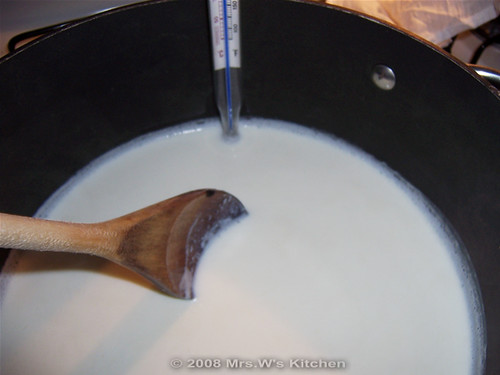
After holding the milk at 175*F for about 10 minutes (still stirring regularly), I slowly stirred in 3 teaspoons of distilled white vinegar. Very few curds formed, even after a good five minutes of stirring. So I added another 3 teaspoons of vinegar and it was like instant magic. The curds came together quickly then.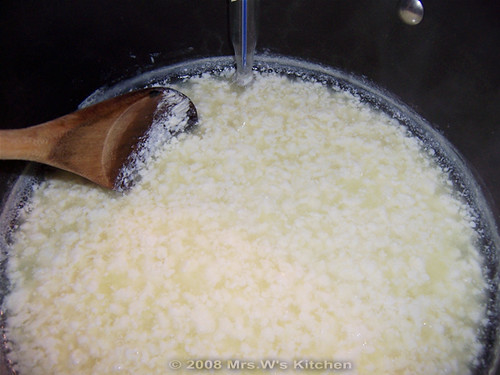
I removed the pot from the heat and poured the whole mess into my prepared cloth-lined colander.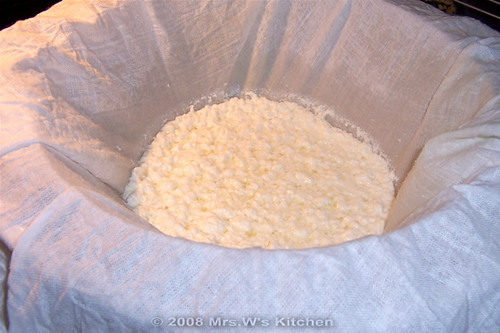
I tied off the cloth into a bag and used chopsticks to support it in a fresh stainless steel bowl for the remaining whey to drain off at room temperature. Meanwhile, I let the whey cool and transferred it to a container in the fridge.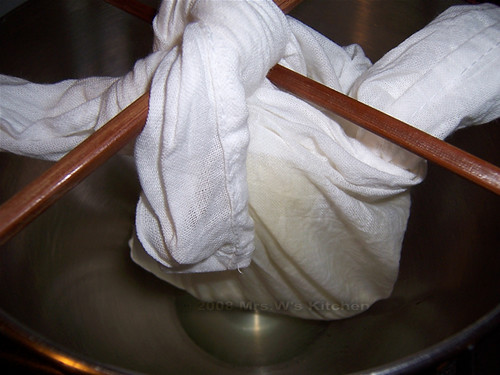
I've read that whey is a good fat-free high-protein liquid to use in recipes--but since I don't make many traditional baked goods (like biscuits or cakes), I'm not really sure what to do with it. Any ideas?
After about 3 hours, the cheese was drained (no more dripping) and fairly dry to the touch. It made about 1-1/2 cups of cheese. However, I wouldn't call it queso blanco. I does not slice at all. It crumbles. It's more of a drained ricotta consistency; the flavor is fresh and sweet.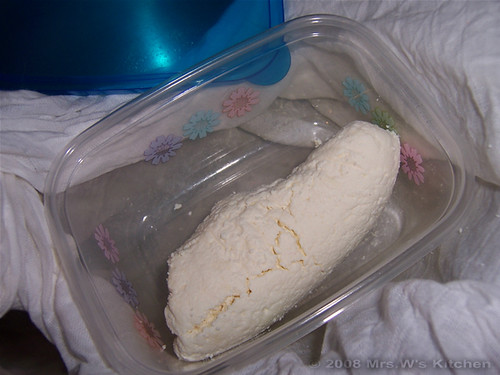
Here are my thoughts:
- The milk I used was ultra-pasteurized, so that may have something to do with my needing to double the vinegar.
- I used white distilled vinegar instead of apple cider vinegar. Could that have turned my project from queso blanco to ricotta?
- By cutting the recipe to suit a quart of milk instead of a gallon, the weight in the bag for draining may not have been enough to compress the cheese enough to form into a sliceable consistency.
- Overall, a good first try, with a tasty, albeit unexpected, result.
If anyone reading has some home cheesemaking experience, I'd love to hear from you, along with ideas about what I might have done wrong.
I used this first batch in a lovely berry granita recipe... I'll post that tomorrow! Meanwhile, I'll post the recipe for the queso blanco, as it's written in the book.
Queso Blanco
from Making Great Cheese at Home by Barbara Ciletti
1 gallon whole goat's or cow's milk
1/4 cup cider vinegar
Heat milk gradually over medium-low direct heat (not in a double-boiler) for 20-30 minutes or until it reaches a temperature of 175-180*F. It's important to heat the milk slowly and stir frequently to prevent scortching.
Hold milk temperature at 175-180*F for about 10 minutes, continuing to stir frequently, lowering heat if necessary. Slowly stir in vinegar until milk acidifies and curds form.
Remove pot from heat. In a sterile basin, place a colander lined with enough cheesecloth or butercloth to tie in a knot. Ladle curds into cloth (retain whey for another purpose).
Tie cloth corners to form a bag. Slice chopsticks or a wooden spoon under knot and hang bag inside an empty milk pot to drain for 3 to 5 hours, or until it stops dripping.
Remove cheese from bag and use immediately or refrigerate in a plastic container. Keeps for 1 week. Makes 1 to 1-1/4 pounds cheese.


