
Okay, you've got some broth ready to roll--but does it taste as flavorful as you want it to? Where do I go from here?
It's a hop, skip and a jump from homemade broth to that rich, flavorful stuff of legend. We're almost there--we just have to add some "oomph."
Asian Influences
You know that I'm a huge fan of asian foods, and soup is no exception. There are some very special differences to asian-flavored broths that can happen quickly at home. Here's how:
Pour your broth in a large pot on the stove. Add 1 or 2 whole star anise, one 2-inch piece lemongrass and a 1-inch piece of peeled ginger, along with added salt and pepper if you have a low-salt broth. You can also add onion and other vegetables that you've lightly charred in the oven, if desired. Simmer gently for 20 minutes (with a lid so your delicious broth doesn't evaporate too much). Remove anise, lemongrass and ginger, then taste your broth. Now you can serve it over cooked noodles and everyone can season their own soup (as in pho), or you can add a splash of soy sauce and about 1/4 teaspoon asian sesame oil right to the pot. I also like to stir in a wee squidge of sriracha chile sauce, because I like things hot!
Beef Up Your Broth
One conspicuously missing element clearly missing from our broth is meat. Enrich homemade broth with pieces of lean meat (raw or leftover) and a slow simmer. We often make little meatballs from ground beef and poach them right in simmering chicken or turkey broth. Or a diced chicken breast or two. Or some leftover pot roast to beef broth.
The Porkify Principle
In my opinion, ham broth is exceptionally wonderful to work with. It is perfect for bean soups--ham and split pea soup, anyone? Apart from bean concoctions, however, I find it rather strong and smoky for other recipes. I like to freeze ham broth in 1-cup and ice cube portions to add richness to other broths. Chicken-Escarole soup benefits greatly with added ham broth. There's just something about it that makes it better.
No ham broth? That's okay--a small can of ham, chopped up and tossed in for 20 minutes or so will do the trick. Or some lunch meat. Or leftover pieces of ham from the freezer. Or a strip of bacon or three. Or a piece of sausage. You decide.
Note: Be aware that pork products are salty. Don't worry too much, though--you can always add a little more water, or a little more low-salt broth to even it out.
Cheater Moves
Don't have the desire to make homemade broth? Need your non-cooking significant other to make something when you're sick? Bullions, pastes and canned broths are all quick ways to get soup ready and on the table. Some products are better than others and depend largely on your personal taste and budgetary concerns.
I've been known to use various convenience broths and bullions, but the one I keep on-hand in the fridge at all times is Better Than Bullion chicken flavor. (Don't hate on me, now!) It's cheap, keeps well, and doesn't taste too bad--with a few helper tricks, that is.
- Make it Low Salt - Buy broths that are low sodium whenever you can. The more you control the seasoning in your broth, the better. Using bullion, granules or paste? Add a little extra water to thin it down. By the time you cook your meat in a thinned lower-salt broth or bullion, add veggies and other fixins and season your soup, it'll taste just fine.
- Porkify - This is the time to put the Porkify Principle (see above) into action. It disguises that from-a-can flavor in a heartbeat. Again, low-salt is key, here, because ham can be salty!
- Meat Juices - This is The Gold Mine Cheater Move of All Time, people. Save your meat juices and fat drippings from other meal preparations. Making a beef roast, meatloaf or rotisserie chicken? Save those drippings. Frying up bacon? Don't throw away the fat--keep it in a jar in the fridge. Fat = flavor! Add a spoonful or two of these juicy bits to add slow-cooked flavor to soups, sauces and even spaghetti sauce.
- Tomato Products - Tomato or tomato-vegetable juice, canned peeled or diced tomatoes, tomato paste or even a little spaghetti sauce are all fantastic additions to any soup, but especially for those using convenience products. Tomato-vegetable juice especially provides added nutrition for your picky eaters. I know that my [slowly recovering] veg-phobic husband gobbles up any soup where I've added V-8!
- Veggie Purees - I often roast eggplant, onions and bell peppers (or sometimes just jarred roasted red peppers) along with tomato paste and garlic to use as a bruschetta/crostini topping or appetizer, but it's also great stirred into soups and pasta sauces or as a pizza sauce. Frozen in ice-cube portions, it gives me the opportunity to hide veggies in things while boosting the taste of convenience products.
- Dried Mushrooms - I don't know about you, but specialty mushrooms are often out of my price range, but a small bag of dried porcini or shitake mushrooms are not overly expensive and can add a tremendous amount of flavor to many, many dishes. Add them sliced or even whole to your soup--or, even sneakier, pulverize your dried fungi in the food processor to a powder and use a tiny spoonful of that for a sure-fire way to disguise your quick broth.
- A Quick Simmer - Thinned low-sodium broth or bullion simmered with chopped onions, carrot and celery for a few minutes is an inexpensive way to give homemade taste to convenience products. Add a little meat of your choice and you're on the path to a delicious broth.
- More Asian Flavor - The same technique described above to turn your homemade broth into something worthy of your favorite restaurant also works for using low-salt broth or bullion.
Tie One On
Beer and wine are great to splash into your soup broths--a little red wine in beef broth, a little white wine in a chicken soup, beer added to vegetable broth, or any combination thereof. Once the alcohol is simmered off, what's left is flavor.
Broth Substitutions
Say you want a seafood soup and all you have is chicken broth. Or vegetable broth. Don't panic--and don't run out to the store to buy something else. Use what you have! A quick simmer with fish & shellfish will translate your, say, turkey broth into a rich seafood-flavored soup in under 10 minutes. For stronger flavor, simmer shrimp heads & shells first and REMOVE THEM before adding your vegetables or other ingredients. Fish doesn't take long to cook, so fresh fish chunks, clams/mussels, shrimp and other seafood go in last for a few minutes before serving. The same goes for chicken and vegetable broths.
Have a recipe that calls for veal broth? Use half poultry and half beef to approximate the flavor.
Use vegetable broth instead of chicken broth and vice versa. There will be a slight flavor difference, but it'll still be good. (Obviously there are exceptions when serving vegetarians or people with other dietary restrictions; for general family use this works very well.)
Soup Recipes
Ingenuity, trial-and-error, and any number of yummy recipes can help you achieve delicious, nutritious, bone-warming-good soup. And now that you have some fabulous, home-made broth at your disposal, it's time to start experimenting!
This concludes my Soup 101 series. I hope this has given you the courage to try some DIY soups for yourself. And now I'm starving for some soup--it's a good thing Mr.W made some this weekend! I'll have it for breakfast in a moment.
Have some soupmaking tips you'd like to share? Add your wisdom in a comment below, or give us a link to your blog post about soup.
Read the entire three-part Soup 101 Series.
Monday, February 23, 2009
Soup 101: Adding Oomph


Friday, February 20, 2009
Soup 101: Broth Basics
Making your own broth is the first step toward quality homemade soups. Many people turn to canned varieties, bullions and pastes instead of making the real thing. Although you can still turn out a decent end result with those convenience products, there is no denying the superior quality of homemade.
Homemade broth can be made from leftover bits, thereby being almost free to make. It does require time and storage, so planning is necessary. And you have the advantage of knowing exactly what's in your homemade broths--convenience products contain a number of unpronounceable ingredients. Who needs that?
Poultry Broths
Bones from a turkey or rotisserie chicken are the perfect beginnings to broth. But even if you don't have the whole bird's bones, you can use the bones that you do have--a breast and leg bone, wing tips, pieces of skin that you removed, and uneaten leftover pieces. Even the neck is good for broth. Keep a container in the freezer in which to store these tasty tidbits for future use. When it's full, you know it's time to make soup.
Too many bones? A recent 22-pound turkey carcass was too big for my largest pot. No worries--I broke it apart and used half, and stored the rest for another batch.
Simple turkey or chicken broth
Place bones & bits in your biggest pot or slow cooker. Add 1 or 2 small onions that you've trimmed but not peeled (for color) and cut in half, along with 2 or 3 small (about 2") pieces of celery, 5 or so baby carrots (or 1 regular carrot, cut into chunks) and water to cover, or nearly cover. Add 1 or 2 teaspoons of salt and several grinds/shakes of black pepper. Err on the side of caution when seasoning--there's plenty of time to add more salt and pepper.
If you're doing this on the stove, cover pot and place over a medium flame and bring to a boil; reduce to lowest flame to simmer, covered, for 2 to 4 hours, stirring occasionally. Or you could transfer your oven-safe soup pot to a preheated 250*F oven for gentle cooking without stove-top tending.
If using a slow cooker, set it to low for 8 hours, or high for 4 hours.
About half-way through your cooking time, taste your broth. Does it need salt? Pepper? Adjust seasoning now.
Some recipes will encourage you to add herbs or spices. Unless I'm making a broth that will be served immediately, I avoid this. Making broth for future soups allows me to make a reduced-salt version that I will flavor later on. You don't want to leave salt out entirely, however. The flavor just isn't very good, and requires a lot more salt later on than if you slowly season throughout the process.
After your cooking time is over, remove from heat and allow to cool for about 30 minutes. Taste again and adjust seasoning if needed.
Place your biggest colander in your largest bowl and ladle in your broth. Assuming there's no usable meat, discard all solids collected in the colander. Otherwise, set solids aside to cool completely before harvesting usable meat. Discard all remaining bits, such as bones, cartilage and vegetables.
Strain broth again through a fine wire mesh lined with cheesecloth to remove any grainy bits. Pour broth into a large container and refrigerate overnight to allow fat to rise to the top and solidify. Remove fat layer. Fat may be discarded or refrigerated for future use. (Some people like to use fat for flavoring. This is a personal choice--no judgment here!)
Now that your broth is defatted, you can store it in bags or containers based on your usual use. If you will be using your broth for soupmaking, larger batches of 1 or 2 quarts will work best for most recipes; if you also plan to use broth for sauces & gravies, make some broth ice cubes and some one-cup portions, as well.
Meat Broths
Meat broths are made exactly the same way as their poultry counterparts. You can use raw or previously cooked bones. If you get bones from your butcher, roasting them in the oven before boiling will yield a richer broth.
And again, save bones from roasts and steaks for future soupmaking. Ham bones make especially delicious broth, but can also be a bit overwhelming. It's great for bean soups and for adding in small amounts to enrich other broths. Lamb shank bones make fabulous broth, as well.
Follow the same poultry broth recipe, substituting your meat bones.
Vegetable Broths
I've made perhaps two vegetable broths in my life. Never a vegetarian, I generally start even veggie-based soups with poultry broth.
Nevertheless, the basics are the same: save your leftover veggie bits. Even trimmed ends from green beans and potato peels will add to the flavor of your broth. Use whatever vegetables you like, along with onions, celery and carrots. Those really are a must. Go easy on stronger veggies such as broccoli and cabbage, because they'll steal the show. Herbs and spices, too, can quickly overwhelm your broth; as with salt and pepper, you can always season it more later.
And don't bother peeling or chopping your veggies--you want to harvest as many vitamins and as much flavor as possible from all usable bits.
Here I'll refer you to a great vegetable broth primer at Cafe Fernando's blog. I couldn't have said it better.
Saving Your Mistakes
Even under-seasoned broths are usable--just bring them back to a simmer with more salt and pepper and desired herbs or, in a real pinch, a wee bit of bullion paste (use caution and taste as you go).
Overseasoned broth can be thinned with water or more, less seasoned broth. Don't throw it away--use it. Remember, by using bones and leftover bits from other meals, this stuff really is almost free to make, so even if you have a failed batch you haven't lost anything but time. Practice makes perfect!
I Want Your Bones
My friends and family know that I'm a soup freak and often call me to pick up their ham bones and poultry carcasses. What's even less expensive than using your own leftovers for soup? Getting them from someone else. Oh, yeah!
Soup's On!
Now that you have some yummy, homemade broth, you're ready to use it in any number of soup recipes that capture your fancy.
Next Time on Soup 101
Oh yes, there's more! In my next post I'll discuss some tricks for giving your homemade broth extra oomph and some cheater tips that'll cause your peeps to bow to your soupmaking prowess.
Thursday, February 19, 2009
Soup 101: Introduction
 This week has turned into a whirlwind. I started the week with some sort of virus that left me rather green around the gills and wishing that food was not a necessary part of life. And that's pretty darned serious! But I recovered lickety-split and had doc appointments and errands... I should probably be exhausted from it all, but I'm not. I seem to have lots of energy to spare. And I have to point to the food that's sustained me this week: soup.
I heart soup. I've sung it's praises many times before, and the several soup recipes that I've already posted are a good indicator of that love. We eat soup a lot--it's warming and hearty, doesn't require a lot of fussing over, and stays hot in the slow cooker while I'm doing other things. We turn to soup during busy times. A simmering pot brimming with yummy goodness and slurpy, nutritious broth is my kind of comfort food.
I especially like to make it for my grandmother. At 88 years old, G'ma is a lifetime lover of soup. From early autumn through the early days of summer, if there's any kind of nip in the air, it's a good day for soup. I guess that's where I get it from. Is it raining? Let's make soup. Snowing? More soup. Ice storm? Soup again.
And over a bowl of soup G'ma will invariably tell you about the many soups she consumed throughout her childhood made by her French immigrant mother. Soup made with lamb, and soup made with beef. Soup made with turkey and soup made with mysterious scraps of this-and-that. It was, after all, the great depression. But no matter what the contents, she describes them all as delicious and her mother as the queen of homemade soup. She'll also tell you that she never could make her own soups, somehow unable to grasp the process. Her kids--my mother, aunt and uncle--never had soup at home until it came out in cans.
This week, especially, I found myself thinking about that. I've always just thrown things together in a pot and made soup. It seems sort of second nature--but obviously that wasn't the case for G'ma. Clearly it's not easy for everyone. Perhaps that's not the case for you, either. So, for you, I'm going to spend a few days talking about soup--Soup 101, if you will.
I could rapture on and on about how soup makes good economic sense, uses up leftovers and stretches your meal dollars; you know this already. But that doesn't make much sense to talk about if you don't know how to do it. And the problem is that there are no specific rules to soup--making broth, especially, is more of a process than a recipe, depends on what you have on-hand, and especially the seasoning takes a lot of tasting--and practice.
With a few basic ingredients, an "I Can Do This!" attitude, and a big pan with a lid, homemade soup is achievable for anyone.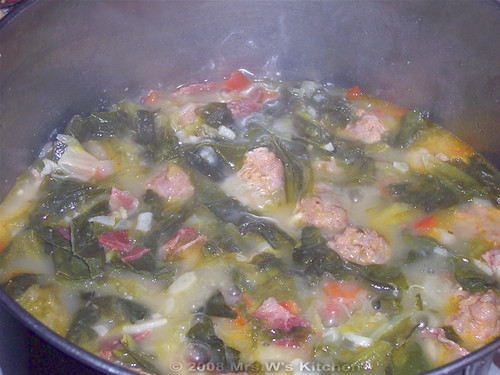 Even your non-cooking life partner can whip up a batch of homemade (or nearly homemade--we'll get to that soon enough) soup when you're too busy, or not feeling well. Mr.W did just that this week. Really! There was a container of turkey broth in the fridge and he took it upon himself to de-fat it, bring it to a simmer, make little meatballs, chop escarole and add tomatoes and barley. What genius! What love! What soup!
Perhaps he knew he had to redeem himself from the cheese poisoning incident. Either way, Mr.W is forgiven.
It brought me back to health and well-being, so much that at my doctor's appointment the staff was impressed by my remarkably speedy recovery from my recent gall bladder surgery and that there was barely a sign of me having been sick earlier in the week at all.
Hooray for me! Hooray for Mr.W! And hooray for soup!


